Fairfax weighs later bells as Springfield families face 7:30 a.m. starts or 4 p.m. dismissals
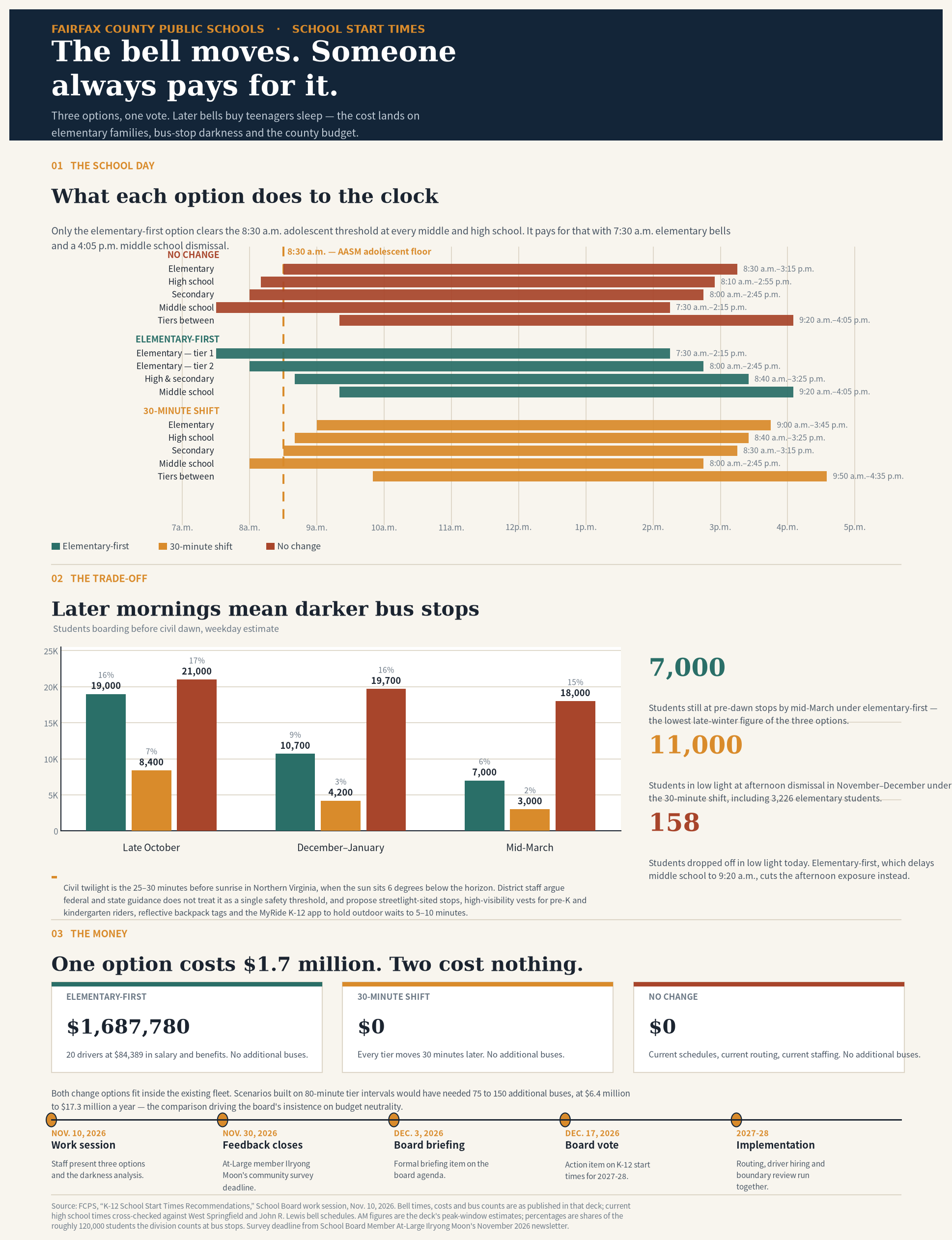
The recommendations lean heavily on adolescent sleep research. The American Academy of Sleep Medicine recommends that middle and high schools start no earlier than 8:30 a.m. Under elementary-first, every high school and secondary school clears that threshold, and every middle school starts after 8:30 — a gain the 30-minute option does not match, since its middle schools would still open at 8 a.m.
SPRINGFIELD, Va. — Springfield's youngest students would start class at 7:30 a.m. and its middle schoolers would not be dismissed until 4:05 p.m. under the option Fairfax County school officials have developed in the most detail as they move toward a December vote on when the county's more than 176,000 students begin their day.
The proposal, presented to the School Board at a work session Nov. 10, would invert the county's long-standing bell order — elementary schools first, high schools next, middle schools last — and reshuffle the morning for tens of thousands of families in Springfield and across Fairfax County.
At West Springfield and John R. Lewis high schools, both of which ring their first bell at 8:10 a.m., classes would begin at 8:40 and end at 3:25 p.m. Irving and Key middle schools, now open from 7:30 a.m. to 2:15 p.m., would run from 9:20 a.m. to 4:05 p.m. — 110 minutes later. Elementary schools, which currently open at 8:30, would split into two tiers starting at 7:30 and 8 a.m.
The board is scheduled to vote Dec. 17 on a plan for the 2027-28 school year, following a formal briefing Dec. 3.
A $1.69 million price tag, or nothing
The elementary-first option would cost about $1.69 million a year, almost entirely for 20 additional drivers at $84,389 each in salary and benefits. It requires no new buses, operating within the existing fleet. District staff contrasted it with earlier scenarios built on 80-minute tier intervals that would have required 75 to 150 additional buses, at $6.4 million to $17.3 million annually.
A second option — shifting every tier 30 minutes later — carries no cost and no new buses. Elementary schools would run 9 a.m. to 3:45 p.m.; middle schools 8 a.m. to 2:45 p.m.; secondary schools 8:30 to 3:15; and high schools 8:40 a.m. to 3:25 p.m.
A third option, no change, costs nothing and preserves the current schedule, which opens middle schools before 7:30 a.m.
Sleep science against daylight
The recommendations lean heavily on adolescent sleep research. The American Academy of Sleep Medicine recommends that middle and high schools start no earlier than 8:30 a.m. Under elementary-first, every high school and secondary school clears that threshold, and every middle school starts after 8:30 — a gain the 30-minute option does not match, since its middle schools would still open at 8 a.m.
The trade-off is morning darkness. District projections show that under elementary-first, about 19,000 students — 16% of bus riders — would board buses before civil dawn during the late-October window. That figure drops to about 10,700 students, or 9%, in December and January, and to roughly 7,000, or 6%, in mid-March.
The current schedule scores worse on that measure: about 21,000 students, 19,700 and 18,000 in the same three windows. The 30-minute option performs best on mornings, at 8,400, 4,200 and 3,000 students, but pushes roughly 11,000 students into low light at afternoon dismissal in November and December, including 3,226 elementary students.
Civil twilight — the 25 to 30 minutes before sunrise, when the sun sits 6 degrees below the horizon — has become the central objection from parents. District staff argued that federal and state highway guidance does not treat civil twilight as a single safety threshold, focusing instead on sight distance, speed limits and lighting. They proposed siting stops near streetlights, issuing high-visibility vests for prekindergarten and kindergarten riders, distributing reflective tags for backpacks, and using the MyRide K-12 tracking app to hold outdoor waits to the district's 5-to-10-minute window.
Staff also flagged a wildcard: the Sunshine Protection Act, which passed the U.S. House and awaits Senate action. Under permanent daylight saving time, more than 95% of the county's 9,320 elementary bus stops would load before civil dawn for 35 instructional days between Dec. 3 and Feb. 8, exposing an estimated 46,500 additional elementary students a day.
Families split, and pressed for input
A fall 2025 survey drew 25,655 participants. The 30-minute shift drew 42% support to 32% for elementary-first. Parents favored the 30-minute option, 46%, while staff favored elementary-first, 37%.
The concerns were more unanimous than the preferences: 84% cited work schedules, 83% extracurricular activities, 75% transportation and 67% morning darkness.
The day after the work session, School Board Member At-Large Ilryong Moon circulated a newsletter to county families inviting them to review the materials and complete a separate survey run by his office, with feedback due Nov. 30.
"Research has shown that school start times can have a significant impact on students' sleep, health, well-being, and academic performance, particularly for adolescents," Moon wrote. "At the same time, changes to school schedules affect more than the school day. They can impact family routines, childcare arrangements, high school athletics, staff schedules, transportation, and other logistical considerations across FCPS."
Moon, who represents the whole county rather than a single district, said he wanted "to hear directly from families about how current school schedules affect your household and how the proposed changes might impact your daily routines." The newsletter carries a standard notice that its views are the member's own and may not reflect those of the full board.
The division has said it will also run a community survey this month, with potential community meetings to follow.
At Springfield's high schools, the later dismissal under both change options moves practices about 30 minutes later, though game times are unaffected. Community use of school facilities begins 2.5 hours after dismissal under the district's agreement, and middle school athletics — whose season would start after 4 p.m. — are still under review for feasibility.
A long, unresolved road
The board voted Oct. 23, 2025, to postpone any divisionwide change until no earlier than 2027-28, allowing time to fully implement new transportation routing software and to weigh a boundary review. It directed the superintendent "to present to the Board, no later than December 2026, a plan outlining viable options for healthy school start times that, where possible, are budget-neutral and minimize impacts on staff."
For Springfield families, the choice comes down to which clock moves. Elementary-first buys middle schoolers nearly two extra hours of morning and costs $1.69 million. The 30-minute option costs nothing and keeps everyone closer to current routines — but leaves 8 a.m. middle school bells and 3:45 p.m. elementary dismissals. Doing nothing preserves the county's early adolescent start times, and its darkest bus stops.
Two open items worth noting before this runs: the deck's monthly bar charts have no underlying data table in the PDF, so any story that quantifies month-by-month exposure would need the raw dataset from FCPS transportation. And I've quoted only Moon, whose text you supplied — no staff or board member is quoted because the presentation contains no direct statements.